How Smart Tools Give You Garage Door Answers Instantly
2026-09-08
Why A Light Bulb Might Be Interfering With Your Garage Door Opener
If your garage door remote has started acting up — working fine up close but losing range, responding inconsistently, or occasionally not working at all — there's a good chance you'd never guess the cause. It's not the remote. It's not the opener. It's the light bulb inside the opener.
This is one of the more surprising and least talked-about causes of garage door opener problems, and it catches homeowners off guard every year. The fix is usually a $5 bulb swap. Here's what's happening and how to sort it out.
How a Light Bulb Can Interfere With a Garage Door Remote
Garage door openers communicate with remotes and keypads using radio frequency signals — typically in the 315 MHz or 390 MHz range. The opener has a receiver antenna that listens for the signal from your remote. When it hears the right signal, it activates the door.
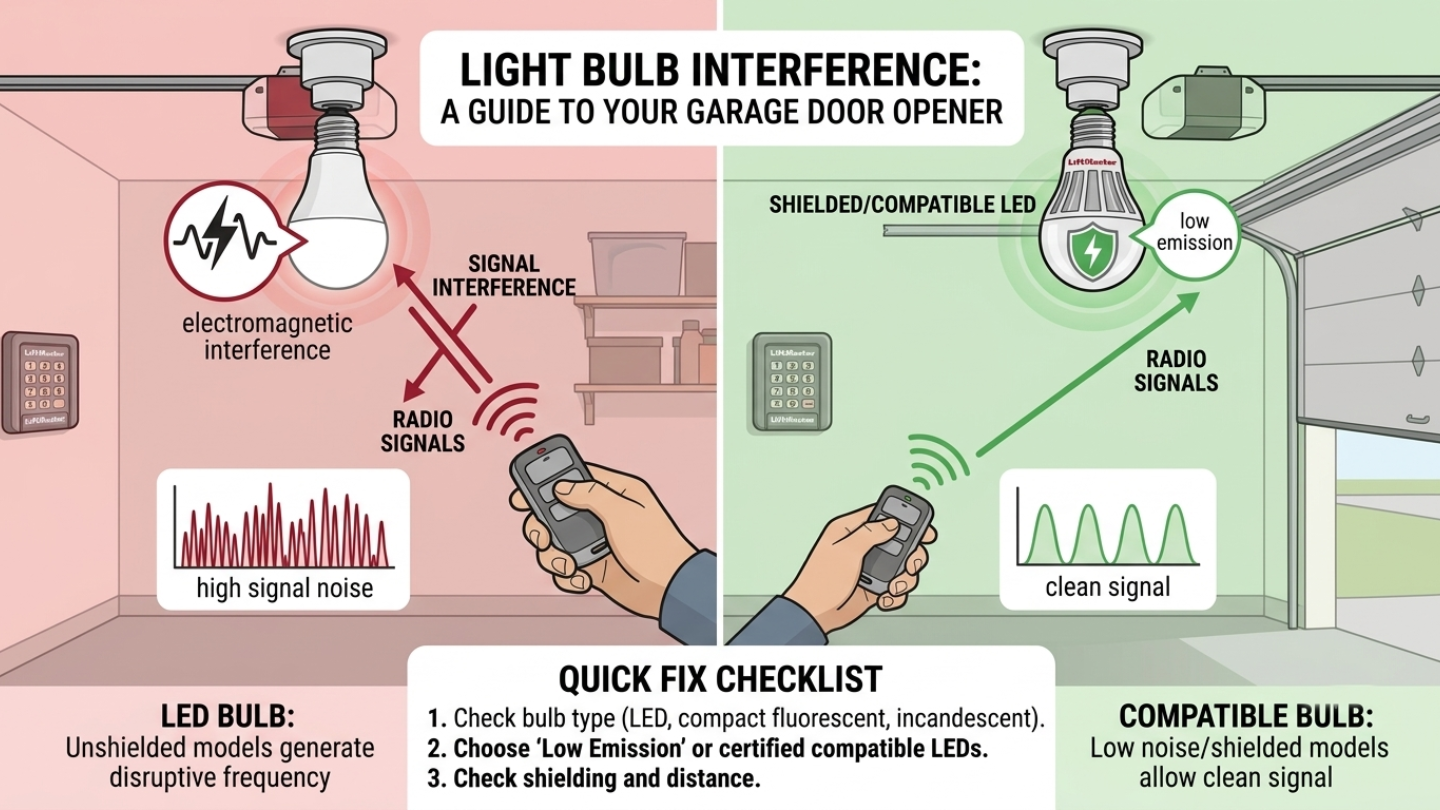
The problem is that certain types of light bulbs generate electromagnetic interference — essentially radio frequency noise — that can overwhelm or partially block the signal the opener is trying to receive. When that noise is strong enough, the opener can't hear the remote clearly. The result is reduced range, inconsistent response, or a remote that only works when you're practically standing under the opener.
The bulbs most likely to cause this problem are CFL bulbs — the compact fluorescent spiral bulbs that became popular as an energy-saving alternative to incandescent bulbs — and certain LED bulbs, particularly cheaper ones without proper RF shielding.
Why CFLs Are the Worst Offenders
CFL bulbs work by running an electrical current through a gas-filled tube, which requires a small electronic ballast to regulate the current. That ballast generates electromagnetic interference as a byproduct of normal operation — it's just part of how the technology works.
The frequency of that interference often overlaps with the radio frequencies that garage door openers use to communicate with remotes. Screw a CFL into your opener's light socket and you've essentially installed a small radio jammer inside the device that needs to receive radio signals.
The interference is strongest close to the bulb and weakens with distance — which is why a CFL in the opener itself is far more disruptive than one on the other side of the garage. The remote signal has to pass through the interference field generated by the bulb inside the very unit it's trying to communicate with.
LEDs — Better, But Not Always Problem-Free
LED bulbs are generally a significant improvement over CFLs when it comes to RF interference, but not all LEDs are created equal.
Cheaper LED bulbs — particularly unbranded ones or those without proper electromagnetic compatibility ratings — can still generate enough interference to affect opener performance. Higher quality LEDs from reputable manufacturers, and LEDs specifically designed for garage door opener use, are built with shielding that minimizes or eliminates the problem.
The other issue with LED bulbs in garage door openers is vibration. The mechanical vibration from the opener running can loosen connections inside cheaper LED bulbs over time, causing them to flicker or fail earlier than expected. Rough service LED bulbs — the kind designed for vibrating environments like garage doors — handle this better than standard LEDs.
How to Tell if Your Bulb Is the Problem
The test is simple.
Remove the bulb from your opener entirely and test the remote from the same distances where it was previously unreliable. If the range and reliability immediately improve with no bulb installed, the bulb was the problem. If nothing changes, something else is going on and the bulb isn't to blame.
You can also test by temporarily swapping in a standard incandescent bulb if you have one available. Incandescent bulbs generate no RF interference whatsoever — they're just a heated wire and don't involve any electronics. If your remote works perfectly with an incandescent and poorly with the CFL or LED, the interference source is confirmed.
The Fix — What Bulb Should You Use?
Best option: Garage door opener specific LED bulbs. Several manufacturers make LED bulbs specifically engineered for use in garage door openers — LiftMaster, Chamberlain, and others sell them. These are designed with proper RF shielding and vibration resistance. They're not expensive, they last a long time, and they eliminate the interference problem entirely. If your opener brand makes one, use it.
Good option: A reputable LED bulb with an FCC Part 15 compliance rating. This rating means the bulb has been tested and confirmed to generate RF emissions below a threshold that causes interference. It doesn't guarantee zero interference but significantly reduces the risk.
Acceptable option: A standard incandescent bulb. No interference, no compatibility concerns. The downside is higher energy use and shorter lifespan compared to LED. But if you're troubleshooting and want a guaranteed no-interference option while you sort things out, an incandescent works fine.
Avoid: CFL bulbs in the opener. There's no good reason to use a CFL in a garage door opener. The interference risk is too high and the energy savings don't justify it when better options exist.
Check your opener's manual for the maximum wattage allowed in the light socket before installing any bulb — most openers specify a maximum of 60 watts equivalent.
Other Things That Can Cause Similar Symptoms
If you've swapped to a compatible LED bulb and the remote is still unreliable, a few other things can cause the same symptoms.
Remote battery. A weak battery reduces the signal strength the remote transmits. If you haven't changed the battery recently, do that before troubleshooting anything else.
Antenna position. The antenna on the opener — usually a thin wire hanging down from the motor unit — should be fully extended and hanging straight down. A coiled or bent antenna reduces reception range. If it's been pushed up out of the way, straighten it out and retest.
Other RF interference sources. LED shop lights, certain power tools, wireless routers, and baby monitors can all generate interference that affects opener range. If the problem started around the same time you added something to the garage, that device may be worth investigating.
Receiver board. On older openers, the radio receiver inside the motor unit can degrade over time and become less sensitive to incoming signals. If you've ruled out bulbs, batteries, and antenna issues and the remote still has poor range, a failing receiver board is possible. This is less a DIY fix and more a reason to evaluate whether the opener is due for replacement.
The Bottom Line
A remote that's lost range or stopped working reliably is worth a bulb swap before assuming anything more serious is wrong. It's a five-minute fix that solves the problem more often than you'd expect.
If you've changed the bulb, replaced the battery, checked the antenna, and the remote is still acting up — or if your opener is showing other signs of age like grinding sounds, slow operation, or inconsistent response — Isabella Garage Door serves homeowners in Mt. Pleasant, Clare, Alma, Coleman, and the surrounding area. Call or text anytime at 989-572-0303.
Raising Performance. Elevating Standards.
You May Also Like

No Guessing Games: How Smart Tools Give You Garage Door Answers Instantly

Planning a Garage Sale? Things To Be Mindful Of With Your Garage Door
From broken springs to malfunctioning openers, learn about the most common garage door issues Michigan homeowners face and how Isabella Garage Door can help.

Why We Love Serving Mt. Pleasant, MI
Why Mount Pleasant is special to us