5 Signs to look out for with your garage door.
2026-05-24
How to Manually Open Your Garage Door During a Power Outage
The power goes out. Your car is in the garage. You have somewhere to be.
It happens to everyone eventually, and if you've never manually operated your garage door before, it can feel more complicated than it is. The good news is that every residential garage door opener made in the last several decades includes a manual release — a simple mechanism that disconnects the door from the opener so you can operate it by hand.
Here's exactly how to do it safely.
Before You Start — Important Safety Check
Before you pull anything, confirm that your garage door is fully closed. This is critical.
The manual release disconnects the door from the opener's trolley, which means the only thing holding the door up once it's released is the spring system. If your door is partially open when you disengage the opener, the door could drop suddenly depending on the condition of your springs.
If your door is already closed and sitting on the ground, you're safe to proceed.
What You'll Need
Nothing special. This is a hands-only operation in most cases. If your garage is dark, grab a flashlight — power outages don't always happen during daylight hours and you'll want to see what you're doing.
Step 1 — Locate the Emergency Release Cord
Look up at the center of your garage ceiling. You'll see a metal track running from the opener motor unit toward the door. Along that track is a trolley — a carriage that the opener drives back and forth to move the door.
Hanging from that trolley is a red cord, usually with a red handle at the end. That's the emergency release cord.
Step 2 — Pull the Emergency Release Cord
With the door fully closed, pull the red cord straight down — or at a slight angle, depending on your opener model. You'll feel or hear a click as the trolley disconnects from the door's drive mechanism.
That's it. The door is now in manual mode.
Step 3 — Lift the Door Manually
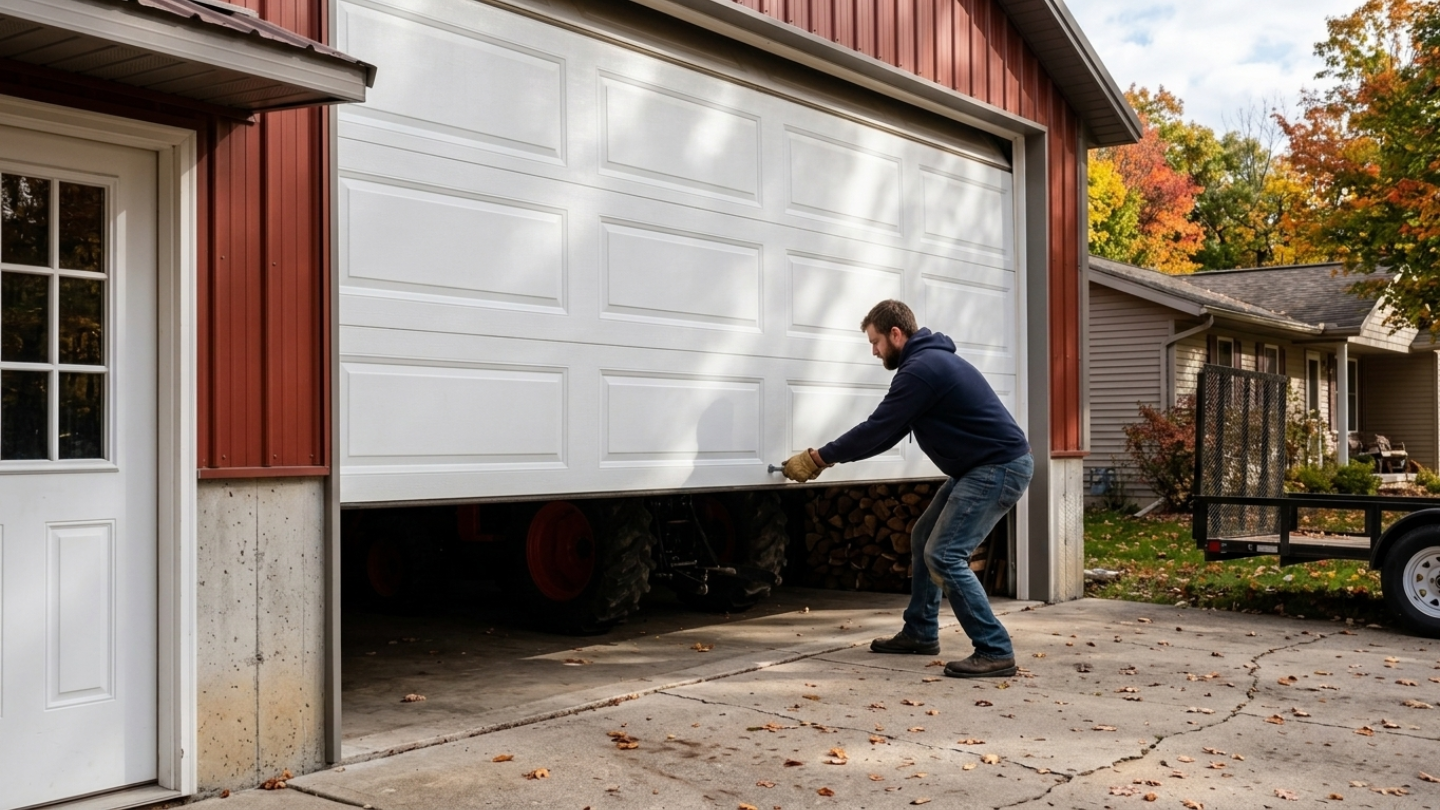
Grip the door handle or the bottom edge of the door with both hands. Lift straight up using your legs, not your back.
A properly balanced garage door should feel relatively light — most of the door's weight is counteracted by the spring system. If your door feels extremely heavy or won't budge, that's a sign your springs may be worn or broken. Do not force it. A door with a failed spring can be genuinely dangerous to lift manually and you'll want a technician to address the spring before operating the door.
Assuming the door lifts normally, raise it until it's fully open. Most doors will stay up on their own once fully raised — the rollers will sit in the curved portion of the track and hold the door in place.
Step 4 — Secure the Door if Needed
If you need to leave your garage unattended with the door open, be aware that a door in manual mode has no automatic close function. Anyone can push it open or closed from either side.
If you need to secure it in the open position while you pull your vehicle out, you can use a clamp or locking pliers on the track just below one of the rollers to prevent the door from sliding down unexpectedly.
Step 5 — Close the Door Behind You
To close the door manually, grip the handle and pull it down. Guide it gently to the ground — don't let it drop. The door should sit flush with the ground and the bottom seal should contact the floor evenly.
If you're leaving and need the door locked, most garage doors have a manual slide lock on the inside. If you're leaving through the garage and need it secured from the outside, use your key lock cylinder on the exterior of the door if your door has one. Not all doors do — if yours doesn't and security is a concern during an extended outage, consider having one installed.
Step 6 — Reconnect the Opener When Power Returns
Once power is restored, you'll need to reconnect the door to the opener before the automatic function will work again.
Here's how:
- Make sure the door is fully closed
- Simply press the wall button or your remote to activate the opener
- The trolley will automatically re-engage the door as it travels — you'll hear a click when it reconnects
- Test the door through a full open and close cycle to confirm everything is operating normally
Some older opener models require you to manually re-engage by pulling the cord toward the opener motor rather than toward the door — if your opener doesn't reconnect automatically, try pulling the cord in the opposite direction until you hear it click back into place.
A Few Things to Know for Next Time
Test it before you need it. The middle of a storm with somewhere to be is not the ideal time to figure this out for the first time. Try the manual release on a calm day so you know exactly how your door operates.
Keep a flashlight in the garage. A small battery-powered flashlight mounted near the door or kept in a cabinet is a simple preparedness measure that pays off when you need it.
Battery backup openers exist. If power outages are common in your area — and in rural Central Michigan, they can be — a garage door opener with a built-in battery backup eliminates this situation entirely. The opener runs off the battery during an outage and recharges when power returns. It's worth asking about when your current opener reaches the end of its life.
Manual operation is one of those things that feels slightly mysterious until you've done it once — and then it's completely unremarkable. Every homeowner should know where their emergency release cord is and how it works before they ever need it.
If you found during this process that your door felt unusually heavy, the spring looked damaged, or the door wouldn't stay up on its own, those are signs worth having a technician look at. A door that's struggling in manual mode is a door that's working your opener too hard in automatic mode.
Isabella Garage Door serves homeowners throughout Central Michigan. Call or text anytime at 989-572-0303.
Raising Performance. Elevating Standards.